
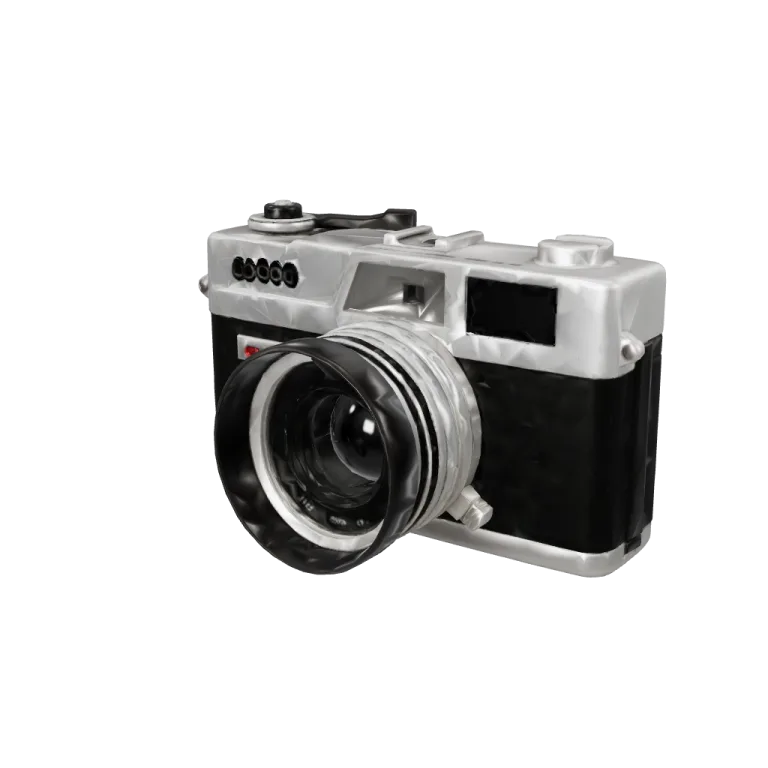
Sample
TRELLIS.2 · image to 3D · a vintage camera
Run TRELLIS.2 online
TRELLIS.2 is an open, MIT-licensed image-to-3D model. This page runs it on hosted GPUs: upload one picture, choose a resolution, and get a GLB with base color, roughness and metallic maps, with nothing to install.
The model in numbers
One run at Draft (512), Standard (1024) or High (1536) resolution; Standard is preselected.
The size of the published model, with open weights under the MIT license.
The model builds a mesh from a single image; it takes no text prompt and no second view.
The vertex budget the GLB is reduced to; 200K is preselected so the file still opens quickly in a browser.
What one run returned
A product photo of a toy robot, run at the preselected settings. The figures describe the file the run returned; the viewer loads a compressed web copy. Open the card to orbit the model.
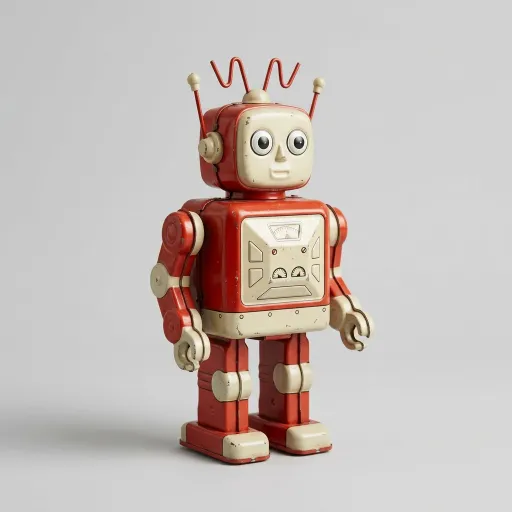
Toy robot, Standard resolution
Open (MIT)199K triangles with a base-color texture and a metal-roughness map; a 7.9 MB GLB after 202 seconds end to end.
The model
What TRELLIS.2 is
The facts below come from the model's published model card, paper and project page.
Released in December 2025
The code and weights came out in December 2025, with the paper on arXiv the same month and the training code in January 2026.
Open weights under MIT
The model card states the MIT license, which allows commercial use; running it yourself needs an NVIDIA GPU with at least 24 GB of memory, and it is tested on Linux.
Shape and material in one voxel grid
TRELLIS.2 is built on a voxel structure called O-Voxel, which encodes geometry and PBR material (base color, metallic, roughness and alpha) together; models are generated at up to 1536³.
Good at hard shapes
The project page highlights open surfaces, non-manifold geometry and enclosed interior structures, with sharp edges preserved.
Run here on hosted GPUs
AI3D Studio runs the published model through an inference provider and bills credits for the GPU time; it did not develop the model. Each result is saved to your library.
TRELLIS.2 settings in this generator
Every option the form shows, with what it changes.
| Setting | What it does |
|---|---|
| ResolutionDraft, Standard, High | The voxel grid the model works at: 512, 1024 or 1536. Higher keeps finer detail and costs 32, 39 or 45 credits. |
| Texture size1K, 2K, 4K | The size of the baked texture images; 2K is preselected and the price does not change. |
| Vertex count50K, 200K, 1M | How far the mesh is reduced before export. The provider's own default of 500K produced a 16.5 MB GLB, so the form starts at 200K. |
| Clean topologyOn | Remeshes the output into cleaner topology. It is on by default and can be switched off under advanced options to keep the raw mesh. |
| SeedAny number | Keep the same seed to repeat a run's starting point with the same picture and settings, or change it for a new variation. |
Make a model from a picture in three actions
The form above is preset to Standard resolution, the middle price.
Upload one picture
A JPEG, PNG or WebP up to 20 MB, with one subject on a plain background and nothing cut off at the edges.
Pick resolution and texture size
Draft, Standard or High sets the price of 32, 39 or 45 credits; the texture size and vertex count are free choices.
Generate and download
The GLB lands in your library when the run finishes; convert it to OBJ, STL, FBX or USDZ in the browser if you need another format.
How it differs from the first TRELLIS
The first TRELLIS, released in December 2024 under MIT, is a different family of models.
One model instead of several
The first release shipped a 1.2B image model and text models from 342M to 2.0B parameters. The new release is one 4B model that takes a picture only.
Textured meshes instead of splats
The first TRELLIS could output Gaussians, radiance fields or meshes. The new model returns a mesh with PBR materials, which is what game engines and slicers open.
Finer voxel grids
It works at 512³, 1024³ or 1536³, the three resolutions this form offers.
When another model fits better than TRELLIS.2
This model takes one picture and returns a GLB. These cases call for something else.
You have several photos
Hunyuan3D 3.1 Pro reads up to eight views of the same object.
You need quads or a T-pose
Rodin Gen-2.5 rebuilds the mesh as quads and stands characters in a T-pose or A-pose.
You only have a description
Text to 3D runs models that start from words instead of an image.
You want every option side by side
Credits, inputs, formats and timings for all twelve generation models.
Known limits of the model
Some come from the model itself, some from running it as a service.
Small holes in raw meshes
The model card warns of occasional small holes or breaks in the surface; repair the model before printing it.
Results vary from run to run
The model has not been tuned to human preference, so a different seed or a cleaner picture can change the result a lot.
GLB is the only native format
OBJ, STL, FBX and USDZ are converted from the GLB in your browser for free after the run.
Slower than the model card
The model card lists about 17 seconds at 1024 on an H100 for generation alone. A hosted run adds upload, queueing and download, and the measured Standard run took 202 seconds end to end.
Questions about TRELLIS.2
Answers about cost, input, speed, licensing and output.
Turn a picture into a model with TRELLIS.2
Upload an image above and run it at Standard resolution.